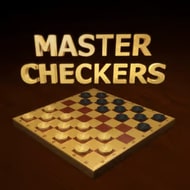
What actually happens the first time you’re forced into a capture you didn’t want to make in Master Checkers? For a lot of new players, that’s the moment the game stops feeling like a casual pastime and starts feeling like real strategy.
| Genre |
Board strategy |
| Platform |
PC and mobile |
| Core mechanic |
Move pieces diagonally to capture your opponent’s checkers and reach the far row |
The Forced Capture Rule Most Beginners Forget
Master Checkers follows the standard rule that if a capture is available, you’re required to take it — you can’t simply ignore a jump because a different move looks safer. This single rule trips up more new players than any other part of the game, since it’s easy to assume checkers is purely voluntary the way it might feel in casual, house-rule play.
Multiple jumps in a single turn are also mandatory when the board allows them, which means one careless move early in a game can open a chain reaction across several of your pieces before your opponent’s turn even starts. Players who come from more relaxed, informal versions of checkers describe this as the single biggest adjustment when they first pick up Master Checkers seriously.
Once you internalize forced capture as a constant threat rather than an occasional rule, your whole approach to positioning changes — you stop asking “where can I move” and start asking “what am I about to force my opponent into.”
Kings, the Back Row, and Why Reaching It Matters
Getting a regular piece to the opponent’s back row promotes it to a king, and kings gain the ability to move backward as well as forward, which turns a single piece into a far more dangerous, board-spanning threat. Protecting your own back row late in a match matters just as much as advancing your own pieces early, since a single unguarded king can unravel a position that looked stable a few moves earlier.
In International Draughts mode, kings become what players commonly call flying kings, able to move multiple squares along a diagonal rather than just one, which meaningfully changes king-heavy endgames compared to English Checkers, where kings still move only a single square at a time.
Choosing a Rule Variant Changes More Than the Board Size
Master Checkers supports several regional rule sets beyond the familiar 8×8 English version, including International Draughts on a 10×10 board, Russian Shashki, and Brazilian rules, each with its own subtle differences in capture requirements and king movement. Players who only ever learn the American version are often surprised how differently a 10×10 board plays, since the extra rows change both opening strategy and how quickly kings can realistically be created.
Competitive-minded players tend to gravitate toward whichever variant has the deepest active player base for ranked-style matches, while casual players mostly stick with whichever version they learned first and rarely switch at all.
Do you have to capture if you can, in Master Checkers?
Yes — forced capture is enforced, so if any legal jump exists on the board, you must take it, and if multiple jump sequences are available you must choose one of them rather than a non-capturing move.
What’s the real difference between English Checkers and International Draughts?
English Checkers is played on an 8×8 board with kings that move one square at a time, while International Draughts uses a 10×10 board and gives kings flying movement across multiple squares, which changes both the pacing of the game and how endgames typically resolve.
How does a piece actually get kinged?
Any regular piece that reaches the opponent’s back row is immediately promoted to a king, gaining the ability to move both forward and backward for the rest of the match.
Whether you’re grinding through English Checkers or testing your patience against a flying king in International Draughts, Master Checkers rewards the same core habit — reading the board two captures ahead instead of just one.