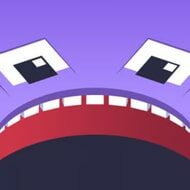
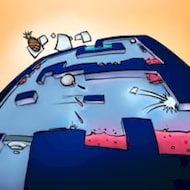
Gobble looks like a cute kids’ game about a mouth that eats stuff, but it plays like a puzzle that punishes careless clicking almost immediately.
| Genre |
Arcade puzzle |
| Levels |
40 |
| Controls |
Mouse or touch drag |
| Fail condition |
Touching a person |
The Mouth, the Objects, and the People You Can’t Touch
You control a mouth buried in the ground, popping up to swallow cacti, rocks, trees, and boxes scattered across each layout. The twist that gives the game its identity is simple: everything on the map is fair game except the people walking around, and touching one ends your run instantly. That one restriction turns what could be a mindless eating loop into something closer to a routing puzzle.
Beginners usually treat the first few levels as a speed test, dragging the mouth in a straight line toward whatever’s closest. That works fine when the map is empty, but the moment a person starts wandering near your path, careless movement gets punished fast. The better habit, and one the game teaches within its first handful of stages, is scanning where the people are heading before you commit to a route.
Clearing all 40 levels without restarting a single one is a realistic benchmark once you’ve internalized this, though most players won’t get there on a first attempt.
Sequencing Objects Instead of Rushing Them
Small objects should generally go first, since eating them grows the mouth just enough to reach slightly larger targets without wasting time circling back. Save the bulkiest obstacles, boxes and trees especially, for once the mouth has grown, because trying to swallow something too large early on just costs movement without progress.
Community vocabulary for this game leans on the phrase “clean pass,” meaning a level cleared in one continuous loop with no backtracking and no near misses with a person. Chasing a clean pass on a level you’ve already beaten is where a lot of the replay value in Gobble actually sits, since the levels themselves are short enough that raw completion isn’t much of a challenge once you know the layout.
Reading a Safe Opening
People on each map don’t move randomly forever, they tend to walk predictable loops or pace back and forth along set paths. Waiting a beat for a person to clear your route, rather than gambling on a gap that might close, is the difference between a clean level and a restart three-quarters of the way through.
Once you reach the later levels, the maps start layering multiple people with overlapping paths, which is exactly when patient players start pulling ahead of players who rely purely on reflexes. That’s a fair criticism some players raise, that the early levels don’t really prepare you for how cramped the later routing gets, and the difficulty spike can feel abrupt if you’ve been coasting on speed alone.
Growth, Puzzle Layering, and Level Variety
Every object eaten adds a small amount to the mouth’s size, and that growth carries visible weight in how the game feels moment to moment. A level that looked impossible at your starting size often opens up once you’ve grown just enough to reach the edges of the map without an extra loop.
This is also where the underground movement mechanic becomes more than a visual flourish. Traveling beneath the surface between pop-up points lets you reposition without crossing a person’s path on the surface, which matters a lot once maps get denser. Players who enjoy planning ahead rather than reacting in the moment tend to gravitate toward using this constantly, treating each level as a short routing problem before they ever touch an object.
By the time you’re deep into the level list, the game stops being about eating quickly and starts being entirely about the order and the path you choose.
- Do you lose progress if you fail a level in Gobble? No, failing or touching a person only resets that individual level, and you can retry it as many times as needed without losing anything cleared earlier.
- What happens if you leave an object uneaten in Gobble? Each round has a time limit, and if any object besides the people is still on the map when it runs out, the level counts as unfinished and has to be replayed.
- Does the mouth in Gobble get bigger permanently? The mouth grows within a level as you eat objects, giving you reach for larger targets, but each new level resets that growth so you’re building it back up from the start every time.
Gobble earns its replay value from something most eating games skip entirely, the people you have to route around, and once you’re chasing a clean pass through a crowded late-game layout instead of just clearing the level, it stops feeling like a kids’ game and starts feeling like the puzzle it always was.