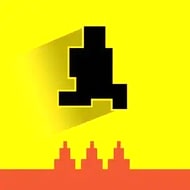
Big Tower Tiny Square looks like a friendly pixel platformer with a cheerful little square for a hero, but it plays like a game that expects you to fail on purpose, over and over, until your timing finally catches up to its traps. The premise sounds almost silly — climb a tower, rescue Pineapple — but the tower itself doesn’t care how charming the setup is.
| Genre |
Precision platformer |
| Core Activity |
Wall-jumping and dodging traps up one continuous tower |
| Goal |
Reach the top and reunite with Pineapple |
| Controls |
Arrow keys or WASD, spacebar to jump |
Climbing the Tower One Screen at a Time
Big Tower Tiny Square isn’t split into separate levels the way most platformers are — it’s one continuous tower broken into single-screen sections, each built around its own trap combination. That structure means there’s no menu to return to between attempts; you’re either climbing or you’re dead and restarting from the last checkpoint.
Beginners often treat the first few screens as a warm-up and hold the jump button out of habit rather than intent. That habit stops working almost immediately, since jump height in this game scales with how long you hold the button, and short taps matter just as much as long ones for threading tight gaps.
Each section teaches its own rhythm before punishing you for ignoring it, which is part of why the game rewards patience over raw reflexes early on.
Wall-Jumping to Reach Higher Ground in Big Tower Tiny Square
The wall-jump is the single mechanic the entire tower is built around. Bouncing off a wall lets you gain height, dodge an obstacle mid-air, or reset your momentum in a narrow shaft where a straight jump wouldn’t clear the gap.
Once you’re a few screens in, sections stop being solvable without it. Casual players who try to muscle through with basic jumps alone tend to stall out here, while players chasing a clean run treat every wall as a resource rather than scenery.
Mastering the wall-jump changes how the whole game reads — screens that looked impossible on a straight run often have an obvious wall-assisted path once you start looking for one.
Reading Lava, Saws, and Lasers Before You Move
By the time you reach the middle stretch of Big Tower Tiny Square, the obstacle roster is in full swing: lava pits that kill on contact, spinning saw blades on fixed loops, laser beams that sweep on a timer, and moving platforms that won’t wait for you to catch up.
- Lava pits — instant death, no partial damage
- Spinning saws — timed loops that reward pausing before moving
- Lasers — sweep patterns that punish rushed jumps
The honest, often-repeated complaint about this stretch is that difficulty spikes can punish a rushed input harder than the section actually deserves, especially the first time a new hazard combination appears without warning.
What the Checkpoint System Actually Forgives
Every death sends you back to your last checkpoint, not to the start of the tower, and that single design choice is what keeps Big Tower Tiny Square from feeling punishing instead of just difficult. Checkpoints sit on safe platforms, usually right after a hard section rather than before it.
This generosity is deliberate. The game fully expects hundreds of deaths across a full climb, and the death counter tracking every one of them is part of the appeal rather than something to hide from.
New players sometimes hesitate at risky jumps out of fear of losing progress, when in reality a missed jump usually costs only a few seconds.
Chasing a Faster Climb in Big Tower Tiny Square
Once you’ve beaten the tower once, the game opens up a second layer entirely: speed. Experienced players can clear the whole climb in 15-plus minutes, while a first playthrough for most beginners runs closer to 1-2 hours of trial and error.
- Learn each section’s pattern before attempting a clean pass
- Replace long jump holds with short taps for precision landings
- Chain wall-jumps without pausing once the pattern is memorized
Speedrunners treat the same checkpoints casual players lean on as timing markers instead, splitting their run screen by screen to shave off seconds.
The Pineapple at the Top
The entire climb builds toward one small, deliberately anticlimactic payoff — reaching the top of the tower and reuniting with Pineapple. After hundreds of deaths and however many attempts it took, the reveal is short on purpose, letting the climb itself carry the weight instead of a big cutscene.
Some players push further after that first clear and attempt a no-death run, treating the entire tower as one continuous test rather than a series of checkpoints to lean on.
How do you wall-jump in Big Tower Tiny Square?
Press toward a wall while airborne and hit jump as you make contact; the square kicks off in the opposite direction, letting you gain height or cross a gap a standard jump wouldn’t clear.
How long does it take to beat Big Tower Tiny Square?
Most beginners need around 1-2 hours for a first clear, while experienced players who’ve learned the tower’s patterns can finish in 15-plus minutes.
Does Big Tower Tiny Square save your progress?
Progress is saved at checkpoints throughout the climb, so dying sends you back to your last checkpoint rather than the base of the tower, keeping each retry short.
Big Tower Tiny Square earns its difficulty honestly — no power-ups to grind, no shortcuts around the wall-jump, just a tiny square, a very tall tower, and Pineapple waiting patiently at the top for however many attempts it takes.