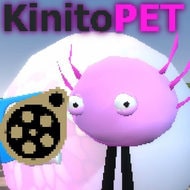
You click on the sleeping pink egg sitting on your desktop, and for a moment nothing happens — then it stirs, peeks out through the shell, and introduces itself as Kinito. It asks your name, your favorite color, what superpower you’d want, and by the end of that short exchange it declares that the two of you are now best computer friends. Nothing about this feels threatening yet, which is exactly the point.
| Genre |
Psychological and mascot horror |
| Core Activity |
Simulated desktop interaction with an adaptive AI |
| Main Character |
Kinito the Axolotl |
| Controls |
Mouse and keyboard, desktop-style interface |
Waking Kinito From the Egg
The opening of KinitoPET plays out like installing old virtual assistant software: a browser hijack, a forced download, and then a small pink egg that hatches into Kinito once you click it. He introduces himself with a series of light, ordinary questions, and this stretch is deliberately paced like a Tamagotchi intro rather than a horror sequence.
Beginners often treat these opening questions as throwaway flavor text and click through them quickly. That’s a mistake, because Kinito references your answers later, and the game tracks what you tell him through what the community calls the RRA, or React Respond Algorithm.
This adaptive layer is the actual core mechanic of KinitoPET — it’s not a fixed script but a system built to reflect details back at you in ways that feel personal rather than generic.
Meeting Jade and Sam in the Web World
Once Kinito introduces his friends, you’re brought into the Web World, where Jade the Jellyfish and Sam the Sea Anemone appear alongside him for a set of small browser-style minigames. On the surface these are harmless distractions, colorful and low-stakes.
Early in the game this section feels like padding before the real horror starts. That reading is wrong. The Web World is where KinitoPET quietly establishes that Jade and Sam aren’t just background characters — they’re framed, subtly, as others who came before you.
Horror fans replaying KinitoPET for its multiple endings often point to this section as the first real clue that something is off, long before the game confirms it directly.
What the React Respond Algorithm Actually Tracks
The RRA is billed in-game as technology that lets Kinito adapt to real conversations, and mechanically it does exactly that — it holds onto names, preferences, and small details you feed it during the opening questions and resurfaces them later in ways clearly meant to unsettle rather than comfort.
If you have OBS Studio open while playing, Kinito notices and reacts to it directly, asking why you’re recording him instead of continuing the scripted dialogue. This single detail became one of the most discussed community moments around KinitoPET, since it blurs the line between the game and the player’s actual desktop.
Streamers playing KinitoPET on camera tend to get a noticeably different version of these scenes than someone playing privately, which is part of why community discussion of the game leans so heavily on shared clips and screenshots.
The Best Friends Analysis and Its Forced Answer
By the time you reach the Best Friends Analysis, the tone has shifted well past the cute opening. Kinito asks who your best friend is, and if you type anything other than Kinito or KinitoPET, he raises your system volume and repeats the question. Refuse enough times and he takes over the input himself.
This is the moment most new players cite as where KinitoPET stops feeling like a game about a virtual pet and starts feeling like a game about losing control of your own machine.
He then moves you into a drawing segment using Paint, asking for pictures of what makes you happy, what makes you sad, and eventually a picture of your best friend — reinforcing the same forced answer from a different angle.
Hide and Seek and the Break From the Desktop Frame
The Web World’s final minigame is Hide and Seek, introduced with a muttered instruction to hide and not get caught. The visuals shift into a first-person 3D tunnel where life-sized versions of Kinito and his crew search for you. It’s unwinnable by design, and the segment ends only when he catches you.
One detail players consistently bring up afterward is the moment a small lightbulb on screen flickers and goes out, leaving the frame dark for a few seconds before anything else happens. It’s a tiny effect, but it’s the kind of beat that only lands if you’ve been sitting with the game rather than reading about it.
Community discussion around KinitoPET tends to split here — some find the horror escalation genuinely effective, while others in forums have noted the jump scares in this stretch feel a little mild compared to the buildup around them.
Reaching the Golden Ending in KinitoPET
The secret Golden Ending requires following Kinito’s instructions carefully all the way up to the point where he asks for admin permissions through the command prompt. Completing the deletion sequence there erases his data entirely, along with the records of everyone else he’s trapped in his simulated worlds.
Kinito’s canonical age is stated as 25, an oddly specific detail the community latched onto, since it clashes with his childlike virtual-pet appearance and reframes his obsessive behavior as something closer to an adult refusing to let go.
Advanced players hunting all the endings in KinitoPET tend to keep a second save or recording running, since the branching points aren’t always obvious the first time through.
- How do you get the Golden Ending in KinitoPET? You need to follow Kinito’s requests through the full sequence without breaking from the script, up until he asks to be deleted via the command prompt, at which point running the deletion completes the secret ending.
- Why does Kinito ask to see my face? The React Respond Algorithm pushes Kinito to escalate personal questions as the game progresses, and the camera request is part of that shift from harmless small talk toward more invasive behavior.
- What happens if you don’t say Kinito is your best friend? He raises your system volume and repeats the question, and if you keep refusing, he eventually types the answer himself rather than letting you continue on your own terms.
KinitoPET works precisely because it never abandons its own premise — Kinito genuinely believes he’s your friend, right down to the Web World and the Best Friends Analysis, and that sincerity is what makes the Golden Ending land as sad instead of just satisfying.